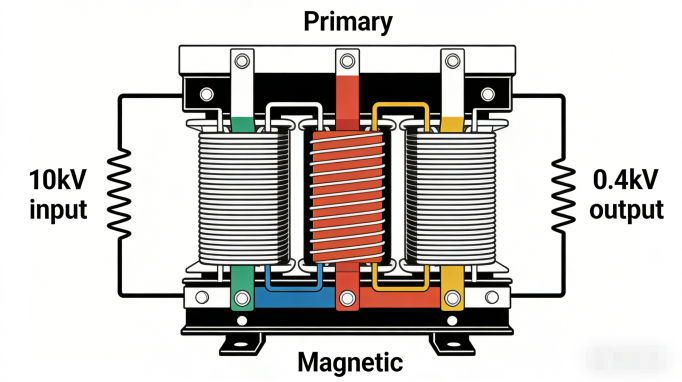
The 10kV/0.4kV distribution transformer is a vital power grid component, relying on the fundamental principle of electromagnetic induction to safely step down 10kV medium voltage to 0.4kV (400V) — the standard for homes, businesses, and factories. Its operation is simple yet precise, ensuring efficient power transfer with minimal energy loss.
At its core, the transformer consists of two key parts: a primary winding (connected to the 10kV high-voltage supply) and a secondary winding (linked to 0.4kV low-voltage loads), both wrapped around a magnetic core (typically silicon steel or amorphous alloy for efficiency). The windings are electrically isolated but magnetically coupled, enabling voltage conversion without direct contact.
When 10kV alternating current (AC) flows through the primary winding, it creates a constantly changing magnetic flux in the core. This fluctuating magnetic field induces an electromotive force (EMF) in the secondary winding — a phenomenon first described by Faraday’s Law of Electromagnetic Induction. The voltage ratio between primary and secondary windings is directly proportional to their turn counts:
Voltage Ratio = Primary Voltage (10kV) / Secondary Voltage (0.4kV) = Primary Turns / Secondary Turns
For a 10kV/0.4kV transformer, this ratio is 25:1 — meaning the primary winding has 25 times more turns than the secondary. For example, if the primary has 2,500 turns, the secondary will have 100 turns, ensuring the 10kV input is reduced to 0.4kV output.
Crucially, the transformer preserves power (excluding minor losses) — so as voltage drops, current increases proportionally. A 10kV input with 10A current, for instance, converts to 0.4kV with 250A current, enabling safe delivery to low-voltage devices like appliances and machinery.
Energy efficiency is optimized by the magnetic core’s design: it minimizes “eddy currents” (wasteful current loops) through laminated steel sheets or amorphous alloy, cutting core losses. High-quality insulation materials between windings prevent short circuits, while cooling systems (oil for outdoor units, air for dry-type indoor models) manage heat from resistance losses.
In short, the 10kV/0.4kV distribution transformer’s operation hinges on electromagnetic induction, turn ratio, and efficient core design — working seamlessly to bridge high-voltage transmission and low-voltage usage in everyday life.